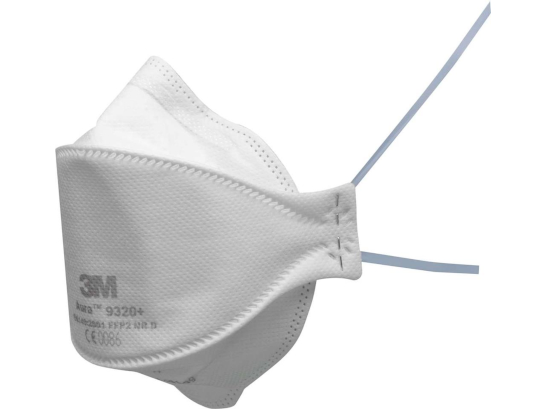

Important information on respiratory protection: Particle masks with ear loops often offer insufficient protection.
European authorities warn of poor fit and leaks in FFP masks with ear loops.
Several recent studies by renowned European occupational safety institutions—including the British Health and Safety Executive (HSE) and the French Institut National de Recherche et de Sécurité (INRS)—point to significant safety deficiencies in the use of respirators with ear loops.
According to the studies, these types of masks often do not seal properly to the face, which significantly impairs their protective function. The seal test, which is considered a standardized procedure for evaluating fit, yielded negative results for nearly all models with ear loops that were tested.
Key findings at a glance:
- Risk of leakage: An inadequate seal can allow particles that are hazardous to health to penetrate – even with filter materials that have been tested in accordance with standards.
- Results of independent tests: 99% of the FFP2 masks with ear loops tested by the INRS failed the fit test.
- Regulatory response: Since January 2024, the British government no longer recognizes respirators with ear loops as compliant with the PPE Regulation (EU) 2016/425 and the EN 149:2001+A1:2009 standard.
Recommendation for employers:
To ensure effective respiratory protection, particle masks with a reliable headband system should be used. These generally provide a better seal and should be selected based on the respective risk assessment, area of application, and conditions of use. Fit testing is required by law in many countries and should be made mandatory as part of occupational health and safety management.
Conclusion:
Choosing the right personal protective equipment is essential for safety in the workplace. Companies are encouraged to review their respiratory protection concepts and, if necessary, switch to compliant mask models.