


Industrial Grinding and Polishing
For professional sanding, we offer 3M sanders, sanding tools, micro-sanding tools, non-woven products, polishing systems, accessories, and more.
With a wide range of products for professional sanding, combined with innovation and the expertise of professionals, our technologies are tailored precisely to your needs.
Grinding:
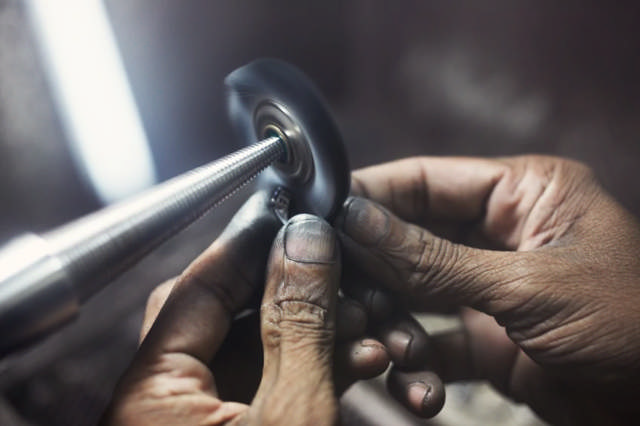
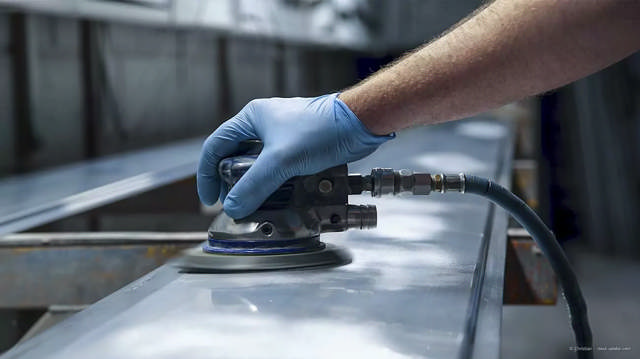
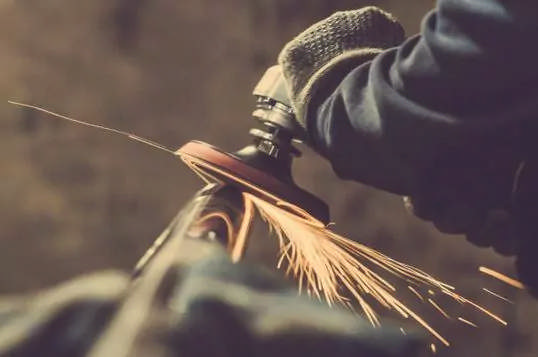
Grinding is a machining process known since ancient times for the fine and finishing machining of workpieces. It can be performed manually or on grinding machines. As with all machining processes, excess material is removed in the form of chips. The cutting edges are formed by the edges of the microscopically small, hard, mineral crystals in the grinding tool. In ancient times, grinding tools consisted of suitable types of stone, such as millstone sandstone. Today, grinding tools are manufactured industrially by combining mineral bulk materials, such as corundum, with a binder to form grinding wheels, stones, or belts.
Grinding, together with honing, is classified as machining with bonded grain, whereas in lapping and sliding machining the grain is loose. Since the number of grains in contact is unknown, as are their geometry and position relative to the workpiece, grinding—like honing and lapping—is classified as machining with a geometrically undefined cutting edge. However, it is known that most grains have a negative rake angle. The chips produced as a byproduct or waste product during grinding are referred to as grinding dust.
Grinding is also suitable for hard materials such as hardened steel or ceramics. The desired shapes of the workpieces are first roughly machined while the material is still soft, and then, after hardening, the final shape and surface quality are achieved through grinding.
Polishing:
Like grinding, polishing is used to remove damage caused by previous machining steps. In polishing, this is achieved in several steps using polishing agents with increasingly finer grit sizes. There are two distinct polishing processes:
Diamond polishing
Diamond as a polishing agent delivers exceptionally high removal rates and optimal flatness. No other abrasive delivers such good results. Due to the hardness of diamond, the polishing agent is suitable for all materials and phases.
When polishing, the goal is to achieve a smaller chip size in order to obtain a sample surface free of scratches and deformations. In this process, polishing cloths with higher elasticity are used together with a very fine grit size, for example 3 or 1 µm, to achieve chip sizes close to zero. Applying less pressure to the sample during polishing also results in a smaller particle size.
Oxide Polishing
Soft and ductile materials in particular require a final oxide polishing step to achieve optimal surface quality. Very good results are achieved using colloidal silica with a particle size of approximately 0.04 µm and a pH of approximately 9.8. The combination of chemical reaction and gentle, light removal results in scratch- and deformation-free samples.
Lapping
In lapping, the lapping compound is applied to a hard surface in the form of a suspension. The particles are not pressed into the surface but roll and move freely in all directions. These movements dislodge small particles from the surface but also deform it significantly, as the freely moving particles cannot remove proper chips from the sample surface.


