


Thermally conductive adhesive films
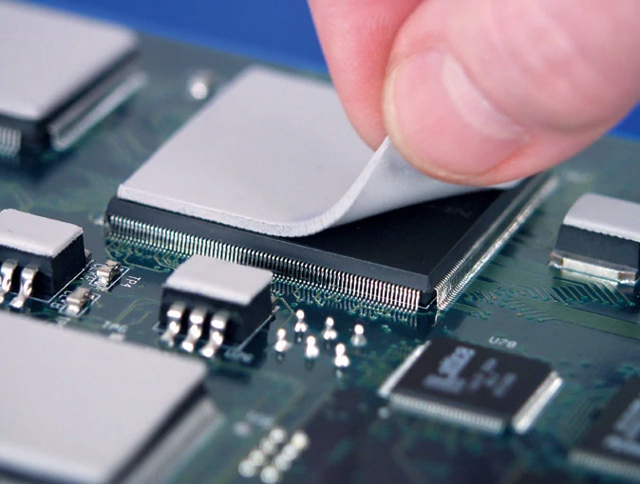
Electronic components are becoming smaller, lighter, and more powerful. However, thermal paths formed by mechanical components are difficult to implement in densely packed high-performance electronics. 3M™ thermally conductive materials offer a solution: These flexible materials conform perfectly to the contact surface, thereby reducing thermal contact resistance. Highly thermally conductive, easy to process, and versatile, 3M thermally conductive materials offer superior design options for thermal management in electronic components.
- Thermally conductive adhesive films
- Thermally conductive pads
- Thermally conductive adhesives
- Thermally conductive epoxy adhesive



3M Thermal Management Lösungen für eine optimale thermische Leitfähigkeit
Electronic components generate heat during operation due to their power dissipation. Heat sinks are used to dissipate this heat. The goal is to prevent the ambient temperature from becoming too high, which would impair component performance and shorten their service life. Specifically for bonding components to heat sinks, 3M offers a complete range of thermally conductive adhesive films, pads, and adhesives that enable efficient heat dissipation.
Thermally Conductive Adhesive Films (9473, 9460, 9469, 8805/8810/8815/8820)
- Thermal conductivity and mechanical fastening
- Replace pastes, clips, screws
- Medium thermal conductivity
- No additional mechanical fastening
Thermally conductive pads (5570, 5571, 5590H)
- Highest thermal conductivity
- Gap-filling
- High thermal conductivity
- Additional mechanical fastening
- High flexibility
Thermally conductive adhesives (TC-2707, TC-2810)
- Minimal outgassing and optimal adhesion
- High adhesive strength
- Good surface wetting
- Ultra-thin adhesive line
- Low thermal impedance
3M’s thermally conductive adhesive films, pads, and adhesives can be used in:
- Electronics
- Automotive industry
- Medical technology
- Testing and measurement technology
- Lighting
- e-Mobility
Compact electronic components require effective thermal management
The trend toward ever-smaller electronic components poses significant challenges for electrical engineers. While compact, high-performance components enable previously unthinkable applications—for example, in the automotive, aerospace, and medical technology sectors—miniaturization also brings increasing challenges for thermal management: Due to high packing density, heat dissipation is insufficient, and the resulting overheating poses the risk of premature wear and poor performance. The challenge for component design is therefore to develop increasingly efficient concepts for heat transfer in densely packed components.
Compact design – high thermal conductivity
Fortunately, there are many successful approaches to better thermal management. They range from mechanical solutions such as specialized PCB designs, optimized fan and heat sink designs, or heat pipes, through improved control electronics, to the innovative, thermally conductive materials from 3M. Compared to mechanical and electronic solutions, these offer the advantage of ease of use combined with high thermal conductivity and additional design benefits for a compact construction.
Silicone-free solutions for sensitive electronic components
3M™ thermally conductive materials utilize the high thermal conductivity of ceramic particles embedded in flexible substrates for heat management in electronic components. The silicone-free variants, in particular, meet the thermal management requirements of microelectronics, as they do not outgass siloxanes and pose no risk of contamination with silicone oils. The range of thermal management solutions for the electronics industry is complemented by the proven elastic bumpers of the 3M™ Bumpon™ series, which act as spacers to promote air circulation.
Heat-shrink tubing
3M heat-shrink tubing and fittings are available in various designs using either cold-shrink or heat-shrink technology. Heat-shrink tubing and fittings offer high mechanical strength, high temperature resistance, and resistance to solvents and chemicals.
Cast resin products
3M offers a comprehensive range of casting resins, as well as connection, branch, and transition kits. Thanks to the unique GMG system (Closed Mixing and Pouring), casting resin kits can be processed safely, cleanly, and quickly.
Labeling products
Proper labeling improves visibility and plays a key role in enhancing safety and increasing efficiency during electrical installation and wiring. The portfolio of professional labeling solutions—all featuring 3M’s renowned quality—includes labeling tapes, heat-shrink tubing, manual labeling systems, and portable labeling devices.
3M Thermally Conductive Epoxy Adhesives
3M TC-2707 Thermally Conductive Two-Component Epoxy Adhesive, Gray, 50 ml
The 3M 2707 thermally conductive adhesive is a two-component epoxy adhesive filled with boron nitride (BN). It offers good thermal conductivity and excellent adhesion to many smooth and rough surfaces. The convenient dual-cartridge system and matching mixing nozzles ensure the ideal mixing ratio is achieved. The adhesive can be applied directly from the cartridge using the applicator.
Properties:
- Minimal outgassing and optimal adhesion
- High bonding strength
- Good surface wetting
- Ultra-thin adhesive bead
Advantages:
- Low thermal impedance
- Good thermal conductivity (0.72 W/m-K)
- Low initial adhesion allows for pre-assembly
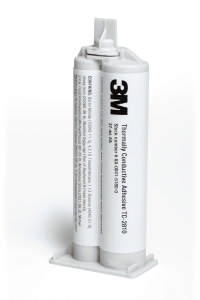
3M™ TC-2810 Thermally Conductive Two-Component Epoxy Adhesive, Gray, 37 ml
The 3M™ 2810 thermally conductive adhesive is a two-component epoxy adhesive filled with boron nitride (BN). It offers good thermal conductivity and excellent adhesion to many smooth and rough surfaces. The convenient dual-cartridge system and matching mixing nozzles ensure the ideal mixing ratio is achieved. The adhesive can be applied directly from the cartridge using the applicator.
Properties:
- Minimal outgassing and optimal adhesion
- High bonding strength
- Good surface wetting
- Ultra-thin adhesive bead
- Very low adhesive thickness possible
Advantages:
- Low thermal impedance
- Good thermal conductivity (1 to 1.4 W/mK)
- Low initial adhesion allows for pre-assembly
.webp&width=640&format=webp)


